
The Standard
What the 1980s GQ Man tells us about masculinity, then and now

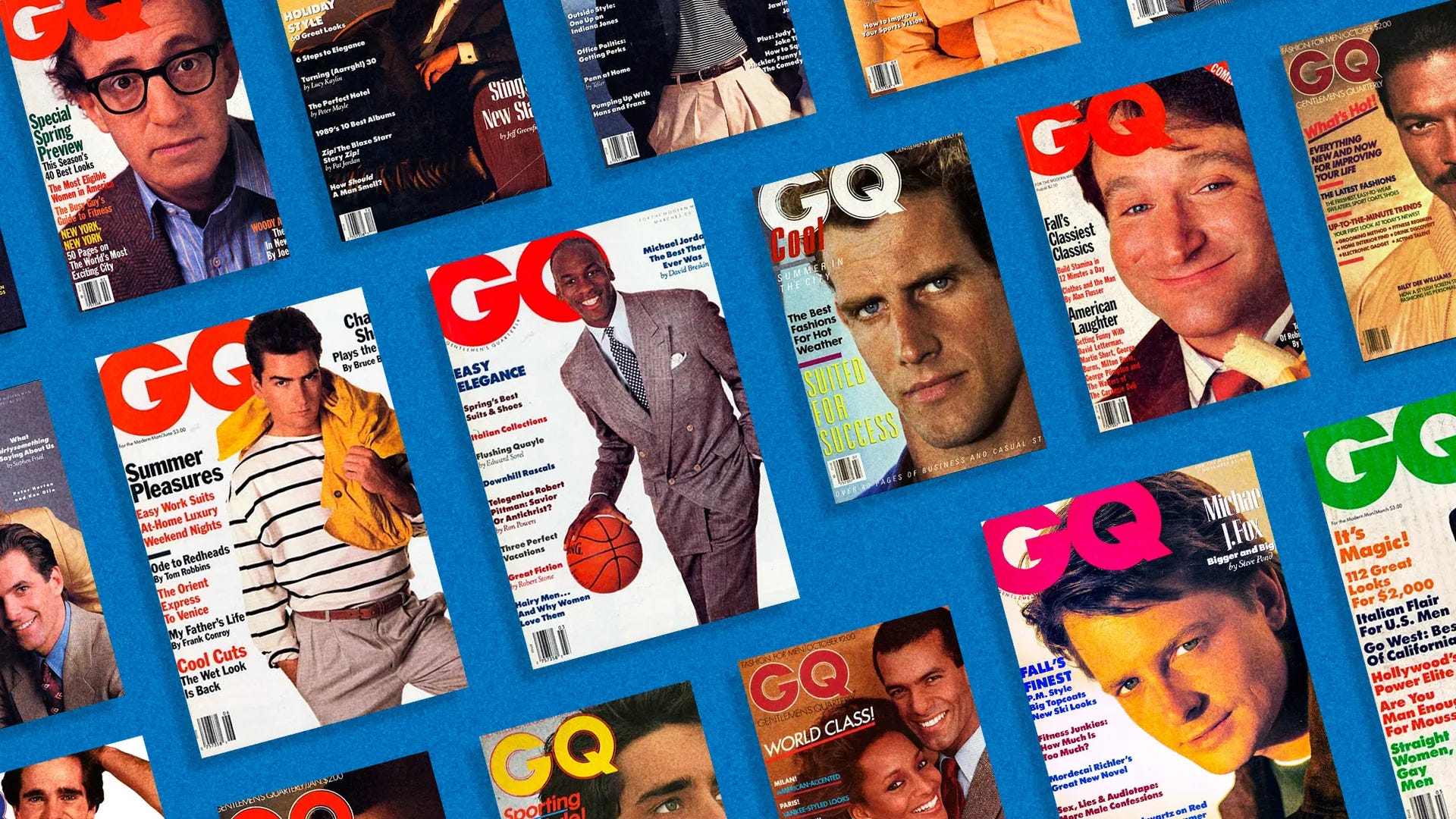
There was a time when you didn’t need to explain what it meant to be GQ.
Whether you grew up in a penthouse or public housing, if someone said you were GQ, you understood it was a compliment. It meant they thought you were stylish, sophisticated, and stood out for the right reasons.
The label comes from the magazine of the same name that started publication in 1957 and continues to this day. It began its life as Gentlemen’s Quarterly, but pulled a KFC in 1967 and shortened the name to GQ.
The holy grail of any brand is to become so ubiquitous, so ingrained in the culture, that it becomes synonymous with its product category. You don’t search for something on the internet, you Google it. You don’t ask for a tissue, you reach for a Kleenex.
GQ did something rarer. It didn't describe a product. It represented an essence. I’ve never heard anyone say, “That suit is Esquire,” or “Your dress is so Cosmo.” But I have heard, “Those shoes are GQ.”
GQ has been on my mind lately because I came across a stack of back issues from the 1980s sitting on a bookshelf in my mother’s house. My brother started subscribing as a teenager and kept it up until he left home. To him, clothing was a form of artistic expression and GQ was one of the places he looked to for inspiration.
I remember him buying a pair of eggshell-colored espadrilles and using masking tape and spray paint to apply horizontal maroon stripes across the toe box. Then there was the time he removed all the buttons from a double-breasted suit he’d picked up at a vintage clothing store. It was brown with a window-pane pattern of thin orange and green stripes. He replaced all the plain brown buttons with embossed gold ones with intricate designs because of something he’d seen in GQ.
I was too young at the time to appreciate the messages he was taking in, but looking at those old editions now is like finding a time capsule that’s been buried in your backyard for 40 years. And what’s buried inside is a version of what masculinity used to look like. A definition of what a GQ Man was, if you will. Everyone had loose opinions about what that meant, but what better place to go for answers than the catechism itself.
After flipping through several issues, I came away with a few rules of thumb about what made a man GQ in the 80s.
1. He was white. That’s not to imply GQ was pushing some version of white superiority. In fact, there were a few black cover subjects through the years like Michael Jordan, Marcus Allen, and Carl Lewis. But once you got past those 6 or 7 associated pages, the other 200 were nonstop ads, profiles, and photo shoots of white guys. But it was a very specific type of white guy. Clean shaven, with a jaw as square as his shoulders. A lush head of hair with a part on the side and a forelock strategically interloping across his brow. Very traditional, old-school masculinity and not apologizing for it. No twinks or soft bellies to be found. Pete Hegseth would approve.
What’s striking when viewed through the lens of today’s discourse is that there was no reactionary element to it. There was no anger in the photos. No sneering backlash to DEI, since no one would even hear that term for another 30 years. Rather, just whiteness presented as a default for what success looked like, but not self-consciously so. It didn’t feel the need to defend itself because it didn’t feel threatened. It wasn’t saying you had to be white to rise to the top. But, if you were black, Hispanic, or Asian and you did, this is where you would land.
2. He really liked gadgets. There were lots of ads for electronics. The Maxell hi-fidelity spots for its cassette tapes is one of the more memorable campaigns, but there were just as many for Pioneer stereo receivers, IBM personal computers, CDs, high-end car stereo equipment, and Casio Data Bank watches. These were the accoutrements of a man on the rise.
But it wasn’t technology for its own sake. It reflected something else: precision. Control. A life arranged with intention. Clean lines, sharp edges, everything in its place. And he never settled for less than the best.
3. He wasn’t overtly political. One of the more refreshing attributes of an 80s GQ man was that it never occurred to him to announce his political allegiances. There were no 80s equivalents of MAGA hats or #BLM t-shirts. Men had opinions. They just weren't identities. Nor were they performed for public consumption.
Even better was that troll culture hadn’t yet emerged because the technology didn't exist for an individual to reach a mass audience. Antagonism couldn’t be monetized or mobilized into power the way someone like Andrew Tate does now. I’m sure many guys in sports bars back then shared a beer over their favorite team not knowing they were on completely opposite sides of an issue important to both of them. But it didn’t matter because they didn’t broadcast their beliefs.
4. He was competent. A GQ man was nothing if not versatile. A suit may have been his uniform, but he was just as comfortable with a screwdriver in his hand. Changing a tire, tying a tie, and checking the oil in his car were not beyond his ken. Style, intellect, and utility were not viewed in opposition, but as complementary pillars of a well-rounded man. Not only that, he was always learning. Maybe a new language or a new recipe. It might have just been to impress his date, but he was trying to be a better version of himself.
It’s a distinct contrast to modern portrayals of men. As an antidote to the domineering archetypes of the past, media shifted in the 90s and beyond to make men appear more vulnerable. In many cases, there was an over correction. Whereas before, men were portrayed as the undisputed head of the household whose judgment was never to be questioned, in the new landscape, that persona was replaced with a bumbling, sometimes pathetic, figure who’s only keeping it together because of his long-suffering wife making up for his deficiencies. Think Homer Simpson or just about any sitcom dad that comes to mind. Either that, or he’s a loner locked in his basement with his video games who lacks the social graces to approach a woman in person.
In the 1980s, it was still okay to be good at things.
5. Celebrity was his inspiration, not an aspiration. Nearly every cover of GQ featured someone famous. Typically a man from the world of sports or entertainment. Harrison Ford, David Letterman, Sting, and Dan Marino. The writeups had the day in the life shots you’d expect. Marino with a ball in his hand, Letterman behind a desk. But the author also wanted to give the reader a peek into the life approach of his subject while presenting him in $1,000 Armani suits.
Yet, there was no celebrity worship in the articles or language inserted to inspire FOMO. No one talked about how he had just come back from walking the runway at Milan Fashion Week or when his new tequila brand was launching. It was usually just an unapologetic view from the top, but not one that was looking down on anyone in the process. The GQ Man consuming it wasn’t trying to be guys he read about. He was still his own man. He just didn’t mind taking tips from someone who had been to places he’d like to go.
Looking back at that time was an enlightening exercise in tracking the ever-moving target of masculinity. What I realized was that the GQ Man was never an avatar for all men, despite how popular the label became. But it did attain a cultural currency across multiple boundaries (race, class, geography) that most social phenomena never achieve.
The new GQ has plotted a different course, one that feels wider and narrower at the same time.
The About section on the website contains the following excerpt:
Crucially, GQ is also the home of the New Masculinity. New Masculinity is an expansion of what it means to “be GQ”—one that moves past a rigid definition of manhood into something more open and inclusive. GQ celebrates creativity, embraces change, and creates culture-shaping moments, including GQ Men of the Year and GQ Global Creativity Awards. It puts an emphasis on diversity, gender equality, sustainability and mental health. To be GQ is to be forward-looking, progressive, and cutting-edge.
The GQ Man of the 80s was a whitewashed monolith, but he knew how to clean the gutters, pick a bottle of wine, and match a paisley tie to a striped shirt without the patterns stepping on each other. His 2026 successor is “forward-looking, progressive, and cutting-edge,” an evolved sensibility, but lacking any particular skills to show for it.
I guess that’s progress.
Maybe.